
When people think of the nineteenth-century House of Orange, King William III usually comes to mind first. His first wife, Queen Sophie (1818-1877), is far less known to the wider public. That is unjust. She was one of the most cultivated and independent-minded women ever to sit on the Dutch throne. On Tuesday 8 December, in our Exclusive Jewellery & Watches sale, part of our Winter Auctions, we are offering two jewels with a direct connection to her. For us, this is a fine occasion to tell her story.
Sophie was born in Stuttgart on 17 June 1818, the daughter of King William I of Württemberg and the Russian Grand Duchess Catherine Pavlovna. Her mother died seven months after her birth. Her father encouraged her to read widely and to educate herself. She spoke German, French, English and some Italian. She read Kant, Hegel, Rousseau and Tacitus, and even translated official state documents for her father. For a princess of that era, this was anything but usual.
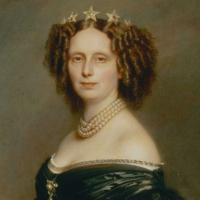
On 18 June 1839, Sophie married her cousin, the Dutch Crown Prince William. It was her father’s wish, not hers. It soon became clear how different the two were. She was sensitive, well read and curious. He was capricious, hot-tempered and had many affairs. The loss of their young son Maurice in 1850 affected Sophie deeply. In 1855 the couple formally separated. From then on she largely lived a life of her own, with Huis ten Bosch in The Hague as her permanent home.
Even so, she was well regarded by the public. When she entered the inauguration ceremony as the new queen in 1849, she was cheered. An old man kissed the hem of her train and called out: “Oh, you are as beautiful as you are good!”
Sophie found her strength in knowledge, art and friendship. She corresponded with the historians Leopold von Ranke and John Lothrop Motley, with the archaeologist Heinrich Schliemann, who discovered Troy, and with the French statesman Adolphe Thiers. Franz Liszt was a frequent guest. She visited the studios of Johannes Bosboom and Jozef Israëls and was a regular visitor to the artists’ society Pulchri Studio in The Hague. In 1875 she even published a substantial historical article on the last Stuarts in the distinguished French journal Revue des deux Mondes. The piece was well received in intellectual circles.
In the later years of her life in particular, Sophie devoted herself to Dutch society. After her visit and donation to the children’s hospital in Rotterdam in 1869, the hospital took the name Sophia Children’s Hospital from 1870 onwards. It bears her name to this day. From 1871 she was patron of Arbeid Adelt (“Work Ennobles”), the association founded by Betsy Perk to help women gain independence through their own work. She was also patron of the Queen Sophia Society for the Protection of Animals.
Sophie died at Huis ten Bosch in June 1877, aged 58. She lay in state in a white gown, covered with her bridal veil. She is said to have chosen this because, in her view, her life had ended on her wedding day. Thousands of people turned out when she was laid to rest in Delft. Her youngest son, Prince Alexander, was so overcome that just before the interment he stepped forward and embraced the coffin.
It is Prince Alexander who links the two jewels in our sale. After his mother’s death, he gave both away as personal mementoes of her.
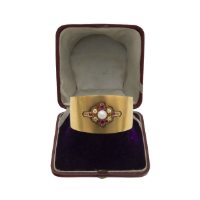
Lot 2038: a bangle she wore herself
This antique 14-carat gold bangle has a broad band tapering at the front. It is set with a cluster of old-cut rubies and diamonds, centring on a pearl. The reverse holds a photo compartment with a portrait of Queen Sophie. The inside of the band is hand-engraved: “Gedragen door Koningin Sophie der Ned geschonken door Z.K.H. Pr. Alexander der Ned. aan J.F. Fransen van de Putte 1 Januari 1878” (Worn by Queen Sophie of the Netherlands, given by H.R.H. Prince Alexander of the Netherlands to J.F. Fransen van de Putte, 1 January 1878). Alexander gave the bangle away just six months after her death. It comes with a photograph of Prince Alexander and is offered in a fitted case.
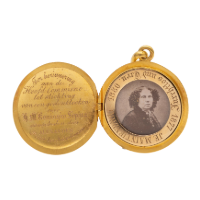
Lot 2033: a locket in her memory
This antique circular 14-carat gold locket is applied with a crowned double crest. The reverse bears an applied letter S between engraved foliage. Inside, behind glass, is a photograph of Queen Sophie, surrounded by the words “Furchtlos und Treu 1877 Je Maintiendrai 1880” (Fearless and loyal, 1877; I will maintain, 1880). The inner lid is engraved: “ter herinnering aan de Hoofd Commissie tot stichting van een gedenkteeken voor HM Koningin Sophia aangeboden door Alexander Prins der Nederlanden” (in remembrance of the Central Committee for the erection of a memorial to H.M. Queen Sophia, presented by Alexander, Prince of the Netherlands).
With these jewels, a piece of history comes under the hammer: the story of a woman who found her own way in a life that was not of her choosing. Her son made sure that her memory lived on.
You are warmly invited to see both jewels in person during our viewing days.
Auction: Exclusive Jewellery & Watches (Winter Auctions), Tuesday 8 December at 7 pm
Viewing: Thursday 3 to Sunday 6 December, 10 am to 5 pm
Location: Venduehuis Auctioneers The Hague, Nobelstraat 5, The Hague
Thanks to Historiek, the independent online magazine about history. www.historiek.net